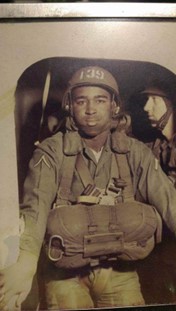
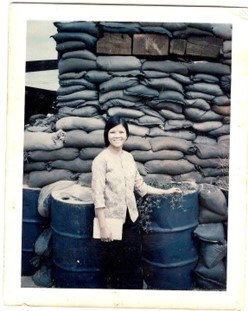
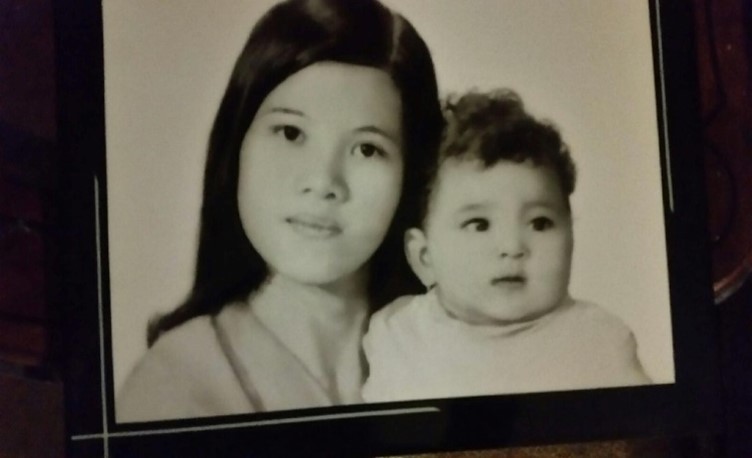
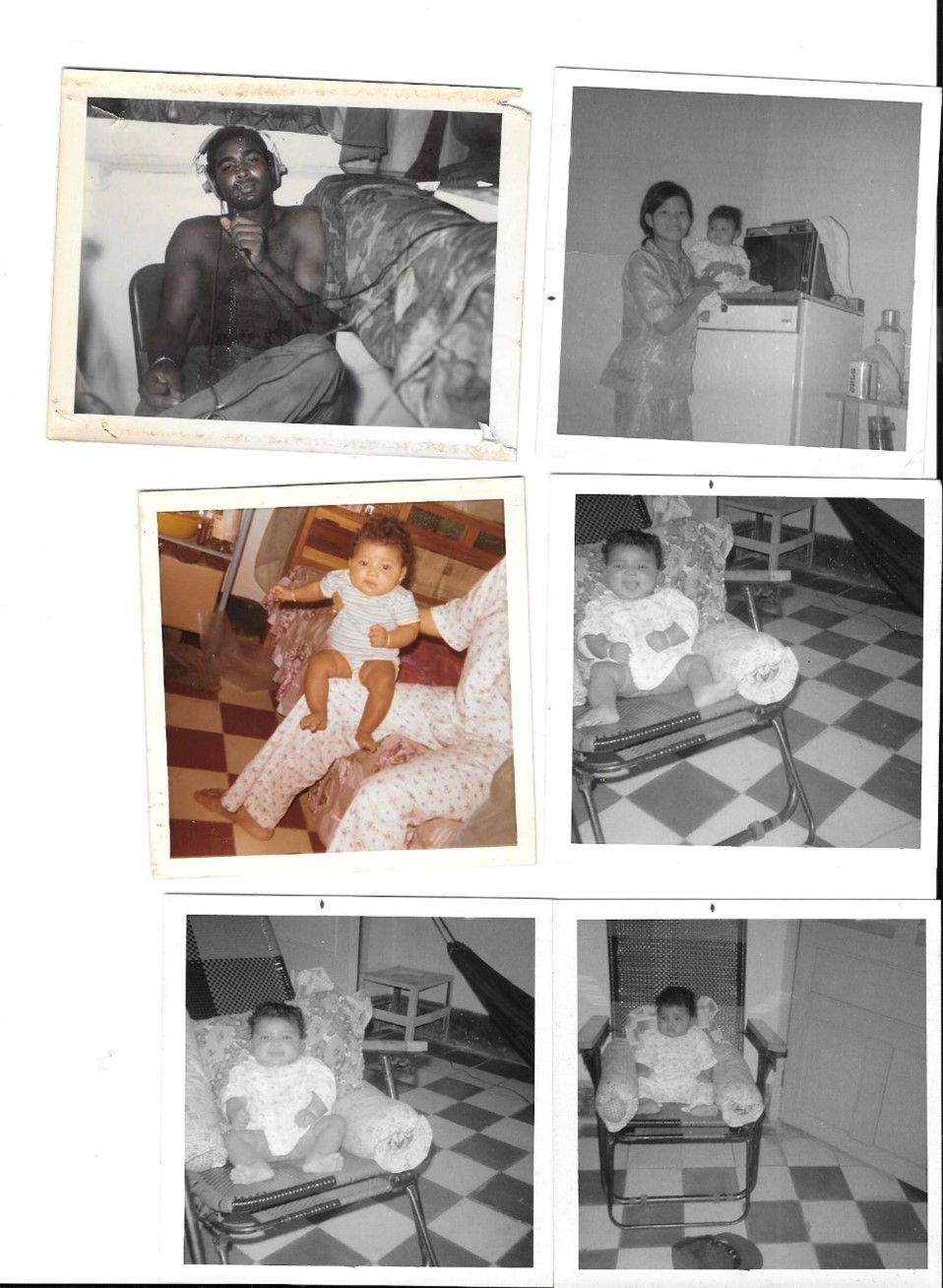
My mom, Chin Nguyen, and dad, Marzel Drisdom, met in 1969 while my dad was serving as the Sergeant in charge of the canteen for a military base in the North English Zone, Quoc Lo I, Tam Quan, Vietnam during the Vietnam War. My mom was hired by the base to cut and empty old sandbags and replace them with new ones for a week until she was transferred to work in the base’s kitchen.
My mom and dad met on the first day that my mom was hired. My mom was working in the sun filling new sandbags with sand. She was sweating and thirsty, but she did not know where to find water and was scared to leave her workstation to ask. Thankfully, my dad appeared with a cup of water in his hand and gave it to her. She appreciated this cup of water very much. They met again at lunch time, when the GIs in the base were lining up to be served food. My mom, along with the rest of the Vietnamese workers, were also lined up to receive food. Apparently, no one would serve the Vietnamese workers, so my dad took it upon himself to make sure they each received food as well. At this time, my mom received two servings of food from my dad by mistake, with my dad using that opportunity to joke with her about it. My mom remembered my dad for his generosity and humor and the two embarked on a relationship.
My mom lived in a village, Quoc Lo I, Tam Quan, near the American base. At some point, my dad was injured and returned to the United States. A few months later, in 1970, he returned to Vietnam, and they continued their relationship for several years. They were in love with each other and secretly married during this time. He took my mom to Bien Hoa, Dong Nai, Vietnam in 1971 and rented a house for her near his base. I was born in 1972.
At some point, my dad was ordered to leave the base and was not allowed or able to visit the village where my mom lived to let her know he was being shipped out or to say goodbye before leaving. Shortly thereafter, several North Vietnamese confronted my mom in her home and warned her that she would be killed if they found out she collaborated with the Americans. My mom promptly destroyed all evidence of any ties to the Americans. She burned all documents like my birth certificate with my given name of T-Wanner So Drisdom (which also included my dad’s full name) and pictures of my dad, and fled the village. A day or two later, the village came under bombardment and the house that my mom used to live in was destroyed, killing all inhabitants. This information was passed on to the American base, without the realization that my mom and I, had fled a day or two earlier. When my dad called to try to get in touch with my mom again, he was told that the house that my mom and I had lived in was destroyed and everybody in it was killed. Despite this news, my dad requested reassignment back to Vietnam to just make sure (hoping beyond hope) but was not allowed to return to Vietnam, so he chose to be stationed in Thailand instead. There, he again attempted to locate my mom and I, contacting the American base and providing me and my mom’s name and information to them. Of course, it was common knowledge that the house was destroyed, and everyone in it was killed. On top of that, my mom had fled and destroyed all paperwork and had a new (fake) birth certificate created with a new name for me and new birth date. Even if he stumbled upon this information, he would not have known it was me and my mom because of the altered information.
He stayed in Thailand for several years during which time he developed a relationship with a Thai woman and brought her home to the U.S. when his tour was complete and married her. He settled in Anchorage, AK and had a daughter and a son with his wife. He and his wife have lived there for over 40 years.
My mon, my younger half-sister and myself came to the United States under the Amerasian Home Coming Act and settled in Oklahoma City, OK on December 18, 1990. I attempted to look for her dad, but my mom discouraged me from finding him. My mom felt that since they have lost contact with him for almost 18 years, he would have a new wife and family with their own kids, and she didn’t want to mess things up for them. I felt so sad hearing what my mom told me, but I kept telling myself, “One day…” Decades later, I have been helping many Amerasians find their dads and I am currently working with about 50 Amerasians from the U.S. and about 300 Amerasians still in Vietnam. As well as helping others locate their fathers, she has also always been trying to find out any information I could about my dad. My mom could only remember his unit, his nickname, Sol, the first two letters of his first name, and an incorrect pronunciation of his last name (Gisdom instead of Drisdom). In 2014, I told my mom that I wanted to take the DNA test to look for my dad – I wanted to see him standing in front of her rather than in an imagined graveyard. Like many of the Amerasians that I helps, I started out with Family Finder DNA, then 23andMe, and finally, the best for last, Ancestry DNA. During my time helping other Amerasians, I met a genealogist who wanted to help me find my dad. After about a year, the genealogist had some success in locating cousins of my dad through Ancestry.com. She contacted many of his relatives, but it appeared that my dad may have passed away already. But that wasn’t true; one of his cousins, Leroy, was reluctant to identify my dad until they knew a little more about me and could confirm my interest was legitimate.
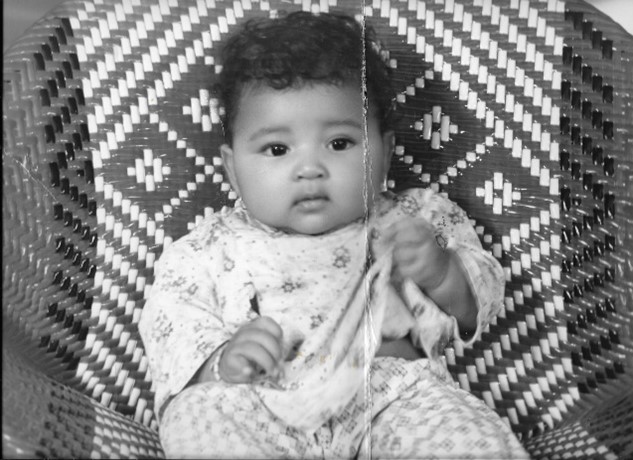
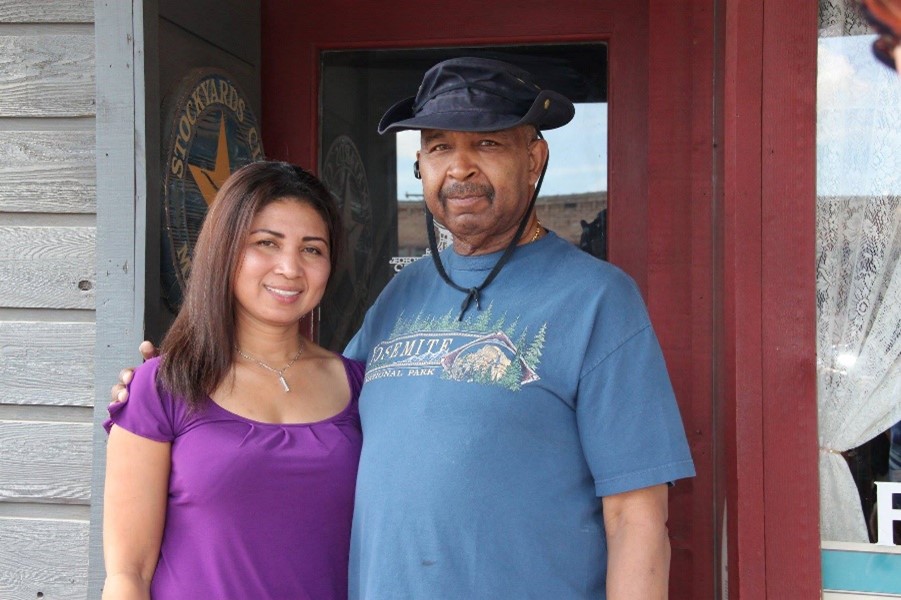
About a year after the initial contact with my dad’s relatives, on the morning of July 3, 2018, I was sitting in my office, dealing with clients and attorneys like any other normal working day, when I suddenly received a message from a strange number with an even stranger area code – 907. The message came from a man stating that he had received a message from his cousin, Leroy, and he confirmed that he is my dad, and I am his long-lost daughter. He event sent me the real birth certificate and pictures of me when I was born through 4 or 5 months of age including pictures of my mom that he had kept all this time. My dad was finally identified, and I found out he was alive. From there, everything’s been a whirlwind of trying to reconnect again. My dad started to connect me to everyone in his family. The first person that she connected to other than my father was my uncle, Arthone Drisdom, and his wife, Odell, and their children. He also connected me to my beautiful 1st cousin Sabrina Petit-Frere, a daughter of my oldest aunt, Shirleen. I was also connected to my beautiful youngest auntie, D-Wanner, my dad’s 1st cousin, Charles, and then the son and daughters of my dad’s God Mother. I was also connected to Mr. Donald Grant, Ms. Sheryl Grant and Ms. Dalphney Blackwell. My dad and uncle Arthone made it out to Oklahoma City in late August 2018 to visit me and my mom again for the first time in almost 46 years.
On September 21, 2018, I flew to Washington DC to attend a conference with Genealogists Angela Trammel, of KinFinder, Cheryl Hester, Milton Washington, and many others. Mr. Washington will publish a book on his life as an Amerasian soon. At the conference, I shared my life story as an Amerasian after my dad left me and my mom, and told of my life after I came to the United States, and my family’s happy reunion with my dad and uncle. On September 23, 2018, I rented a car and drove from Washington DC to Virginia Beach to see my uncle‘s family. I called my uncle and let him know that I am my way to visit his family. It was a three-hour drive to Virginia Beach, but I didn’t call until I was 59-minutes away because I wanted it to be a surprise visit. When I arrived at my uncle’s house, my uncle and his wife, Odell, standing in front of their house waiting for me to arrive. My aunt-in-law, Odel, was happy and welcomed me with open arms and love to their family. I also met my youngest 1st cousin, Anthony, and my uncle’s grandchildren. Later on that day, my aunt-in-law, Odel, introduced me to her mother, and we had a wonderful dinner at Odel’s mother’s house. I appreciated the warm welcome dinner at my aunt Odel’s mother’s house, and the love my uncle and his wife have for me. “The lost baby girl Drisdom now returns as an adult Drisdom to the Drisdom family.”
Jannies (T-Wanner So Drisdom) Nguyen.
The following is an article written by Shandon Phan about the history and adjustment experiences of Amerasians — children born to Vietnamese women and American military personnel during the Viet Nam War.
The following is an article written by Shandon Phan about the history and adjustment experiences of Amerasians — children born to Vietnamese women and American military personnel during the Viet Nam War.
“Daughter from Danang,” a well acclaimed and Oscar-nominated documentary, followed the journey of Heidi Bob, born to a Vietnamese mother and an American serviceman during the Vietnam War, to see her mother for the first time ever since she left Vietnam at the age of seven. While I personally found the documentary emotionally engaging and thought-provoking in its exploration of the issue of identity and cultural connection, I wonder when the other side of this story about Amerasians will be told. And who would listen?
I want to talk about the experience of approximately 20,000 fellows who also shared the same Amerasian-by-birth background with our character Heidi, but unfortunately never had the full opportunity to search for their true identity and social acceptance. The story of . . . Amerasians — “Children of the Dust.”
Vietnamese Amerasians, commonly referred to as Amerasians, are children of America’s Viet Nam War. Some were brought over to America in the final days of the war as part of “Operation Babylift.” Although this program was strongly criticized later by the American public as a culturally insensitive approach toward Amerasians, it rescued those children like Heidi from suffering a troubled childhood if they had ever grown up in Vietnam.
Called “children of the dust” by the Vietnamese, Amerasians were badly mistreated and often denied basic civil rights, especially the right to have a basic education. Growing up in a Confucianism-influenced and patriarchal society, they were mostly isolated by their peers for the absence of their father and their non-Vietnamese appearance.
Things got worse under the Communist regime after the war ended — the new government viewed them as “children of the enemy.” Left behind by their American fathers and rejected by Vietnamese society, Amerasians just had to accept their misfortune. Or perhaps, they waited and hoped for an unforeseeable change.
As America recovered from the turmoil and bitterness resulting from the Vietnam War, there was a growing sentiment across the nation to take care of America’s “forgotten sons and daughters” left behind in Vietnam. During his speech to a Senate sub-committee in 1980, Senator Stewart B. McKinney spoke of the Amerasian issue as “a national embarrassment” and called on America’s patriotic duty to take full responsibility for Amerasians.
As a result, the Homecoming Act was written in 1987, passed by Congress in 1988 and implemented in 1989. Under the Vietnamese Amerasian Homecoming Act, approximately 25,000 Amerasians have arrived in America with their immediate relatives. Altogether they number 77,000 according to a national survey conducted by Ohio State University.
Amerasians, born between 1962 and 1975, were mostly grown-up adults when they arrived in America in the early 1990’s. Leaving behind all the hardship and difficulties in Vietnam, they looked forward to a new chapter in their life, expecting to finally find home and have an identity they always yearned for. However, they soon found themselves trapped in an unresolved dilemma: neither Vietnam nor America is truly home.
The same study from Ohio State University found that 76 percent of Amerasians wanted to meet their fathers when they came to the United States, but only 30 percent knew their fathers’ names. About 22 percent of them had tried to make contact and only 3 percent had actually succeeded in meeting their biological fathers. In reality, American fathers do not want to meet their left-behind children, because of fear, embarrassment or lack of responsibility.
“When you go from 76 percent of these children wanting to meet their fathers to only 3 percent actually doing it, it’s not hard to see where this would cause psychological problems,” said Fred Bemak, professor of counselor education at Ohio State University. Once again, Amerasians felt a sense of loss, abandonment and loneliness. Having left their mother’s country, they once again became strangers, alienated now in their father’s land.
And the question of identity still remains . . . Vietnamese or American? Based on the results of various studies conducted nationally, the U.S. General Account Office found that half of Amerasians in America today do not know where they truly belong. To the Vietnamese, they look like White and Black Americans. And to Americans, they are considered as aliens because of the differences in culture, language and immigration status. Where’s the American Dream?
Originally scattered across the country when they first arrived in America, today Amerasians concentrate in metropolitan areas, usually around the Vietnamese community. They form networks of small groups among themselves for emotional and social support. However, life in America is still a daily struggle against poverty and all kinds of problems: mental health, social isolation, discrimination, language barrier, lack of job opportunities, violence. Due to their lack of education and survival skills, most of them can only find low-paying, entry-level jobs and live in poor, poverty-stricken neighborhoods. And many continue to show symptoms of psychological disorders.
Ironically, 15 years after having come home, the vast majority of these Amerasians remain “aliens.” Illiterate in their own mother language because of their lack of education in Viet Nam, few of them can read or write in English no matter how hard they try. This deficiency in English has disqualified them for the naturalization process to become U.S. citizens. Not recognized as Vietnamese in Viet Nam, they have no prospect to ever become U.S. citizens in America.
There have been academic studies and social surveys about Amerasians. These studies and surveys however do not help the Amerasians reach their dream of having a place to call home, an identity recognized and accepted by their fellows, and a future that is brighter than their sad past in Vietnam.
Currently, Boat People S.O.S. is leading a national campaign to urge the U.S. government to recognize the citizenship of these children of Americans. Congressman Nick Lampson of Texas endorsed and encouraged this humanitarian endeavor: “This is the right thing to do and we cannot wait any longer.”
It’s time that all of us, members of the Vietnamese community and citizens of the U.S., need to take a stand to do the right thing for our “con lai” (half-blood) brothers and sisters. Only then, the constitutional belief of everyone’s right to his or her pursuit of happiness in this land of opportunities would hold true.
Copyright © 2003 by Shandon Phan.

Director: Jannies Nguyen-1444 NW 24th St. Oklahoma City, Ok 73106. Email: jannies@acovv.org.
Amerasian Children of Vietnam Veterans, Corp. EIN# 37-1786449
Copyright 2024. Website.com. All Rights Reserved.